 Skip to content

If you have ever used Google News, Flipboard, Feedly, or Rotten Tomatoes, you have already interacted with a content aggregator site. In simple terms, a content aggregator site gathers information, articles, media, or updates from multiple sources and displays them in one convenient place for users to browse. That basic definition is widely consistent across industry explanations of content aggregation.
But there is a lot more to understand if you want to know whether a content aggregator site is useful for your business, brand, publication, or startup.
In this guide, you will learn:
- what a content aggregator site is
- how content aggregator websites work
- the different types of aggregators
- real-world examples
- benefits and drawbacks
- SEO considerations
- how to build one the right way
What Is a Content Aggregator Site?
A content aggregator site is a website or platform that collects content from different publishers, creators, feeds, or platforms and organizes it into a single destination. The content may include news stories, blog posts, podcasts, videos, product reviews, social media posts, job listings, or industry updates.
The main goal of a content aggregator site is to save users time. Instead of visiting multiple websites individually, users can find relevant information in one place.
Simple definition
A content aggregator site is a platform that pulls content from multiple sources and presents it in a structured, user-friendly format.
How Does a Content Aggregator Site Work?
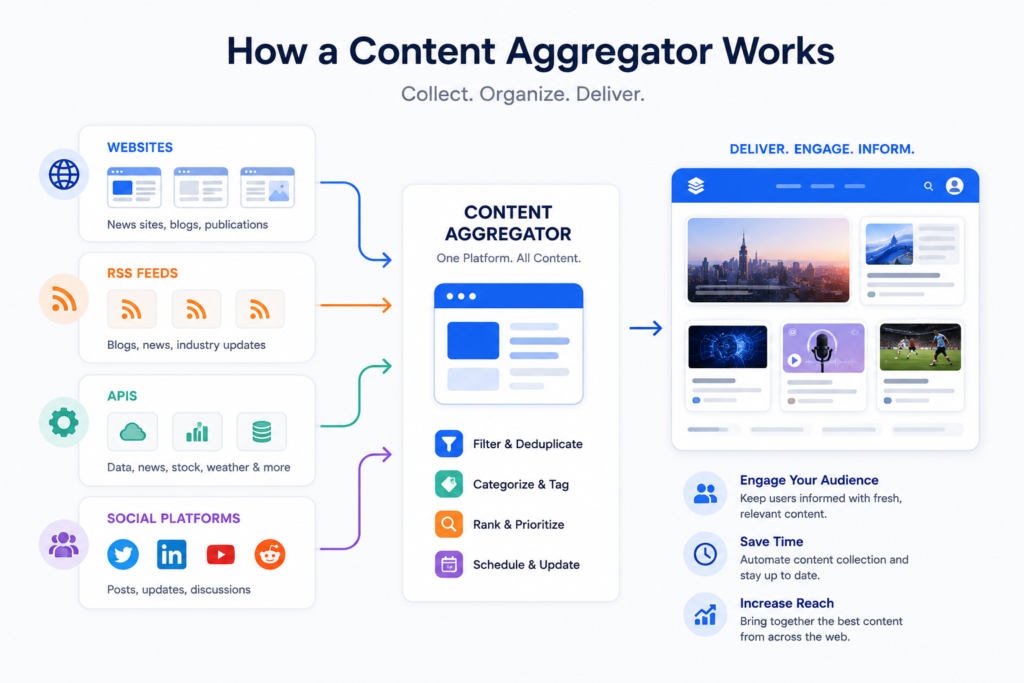
Most content aggregator sites work through one or more of these methods:
1. Content collection
The site gathers information from different sources using RSS feeds, APIs, direct submissions, scraping tools where permitted, editorial curation, or partnerships. RSS readers have long been a classic example of aggregation, as they compile updates from multiple sites into a single feed.
2. Content filtering
The platform sorts content by topic, category, keyword, popularity, freshness, location, or audience preference.
3. Content organization
The content is then displayed in a clean layout, often with headlines, summaries, thumbnails, ratings, or tags so users can browse efficiently.
4. Redirection or hosting
Some aggregator sites only show a headline and summary, then send users to the original source. Others host excerpts, reviews, or embedded media directly on their own platform.
5. Personalization
Many modern aggregators allow users to customize feeds based on interests, industries, creators, or keywords.
Types of Content Aggregator Sites
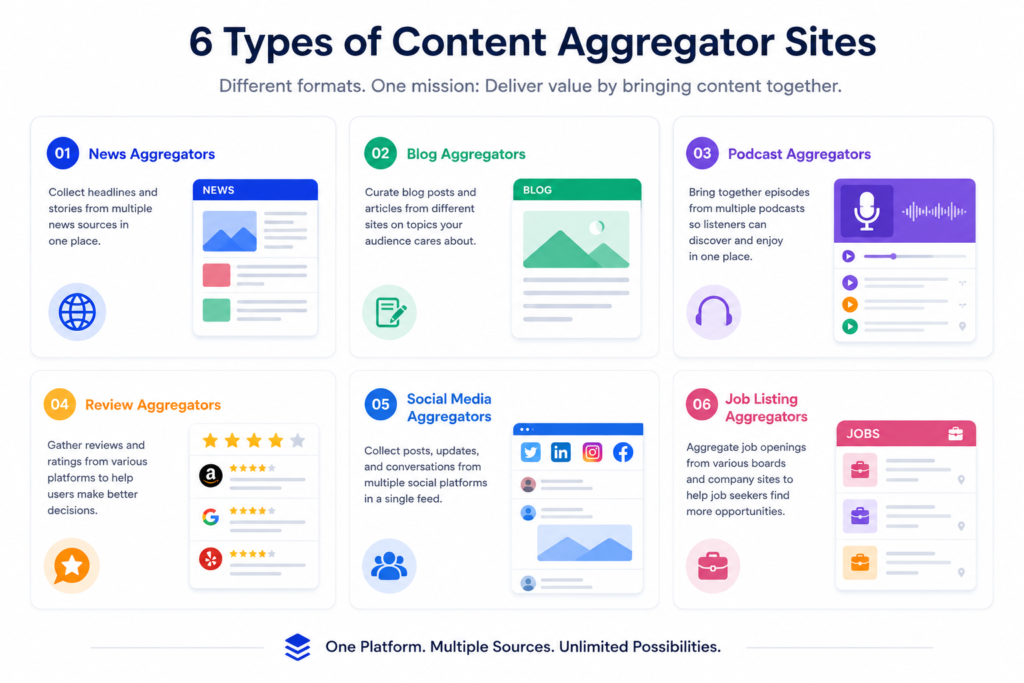
Not all aggregator websites work the same way. Here are the most common types.
News aggregators
These collect news stories from multiple publishers and present them by topic, trend, or region. Google News is one of the best-known examples, and TechTarget also lists Google News and AllTop among notable aggregators.
Blog and article aggregators
These gather blog posts, thought leadership content, and niche articles from around the web.
Social media aggregators
These pull together posts from platforms like Instagram, X, YouTube, TikTok, or LinkedIn into one stream or campaign hub. TechTarget identifies social media aggregators as a distinct category.
Review aggregators
These combine ratings and reviews from different sources. Rotten Tomatoes is a classic example listed by TechTarget.
Podcast and media aggregators
Platforms such as podcast directories aggregate episodes from many creators into a searchable library. TechTarget also points to Apple Podcasts as an example of aggregation.
Job, deal, or product aggregators
These compile listings, offers, prices, or product data from multiple websites and help users compare options quickly.
Niche industry aggregators
These focus on one vertical, such as SaaS, finance, marketing, healthcare, travel, or real estate.
Examples of Content Aggregator Sites
Examples help make the concept easier to understand. Industry references commonly point to these types of sites:
- Google News for aggregated news
- Feedly for articles, blogs, and web updates
- Flipboard for curated articles and media
- Rotten Tomatoes for review aggregation
- Apple Podcasts for podcast discovery
These examples show that content aggregation is not limited to news. It can apply to nearly any kind of digital information.
Why Do People Use Content Aggregator Sites?
The main reason is convenience. A content aggregator site reduces the time and effort required to stay updated.

Benefits for users
Users like aggregators because they:
- save time
- reduce information overload
- simplify research
- make discovery easier
- allow personalized browsing
Benefits for businesses
Businesses build or use aggregators because they can:
- become a go-to resource in a niche
- attract repeat traffic
- increase topical authority
- support newsletter growth
- generate ad, affiliate, or subscription revenue
- create a scalable content hub
A well-structured aggregator can become a strong audience-building asset when it adds organization, context, filtering, or expert curation on top of raw content collection.
Why a Content Aggregator Site Can Be Valuable for SEO
A high-quality content aggregator site can support SEO when it adds unique value rather than simply copying content.
SEO advantages
A good aggregator can help by:
- targeting long-tail topics at scale
- covering an industry comprehensively
- earning backlinks as a useful resource
- keeping pages fresh with regular updates
- increasing internal linking opportunities
- capturing search demand across many subtopics
The catch
Aggregation alone is not enough. Search engines are more likely to reward pages that offer:
- original summaries
- smart categorization
- expert commentary
- strong UX
- clear sourcing
- helpful filters and comparisons
If an aggregator only republishes thin or duplicate material, it may struggle to rank.
Common Problems With Content Aggregator Sites
Many aggregator sites fail because they focus only on collecting content, not improving it.
1. Thin content
If pages contain nothing more than copied headlines or short snippets, users and search engines may see little value.
2. Duplicate content risk
If too much text is reproduced from other sources, the site may have difficulty standing out.
3. Copyright and licensing issues
Not every source allows republication. Aggregator site owners need to follow usage rights, terms, and attribution requirements.
4. Poor quality control
Without moderation or editorial review, low-quality or irrelevant content can fill the site.
5. Weak differentiation
If users can get the same experience elsewhere, the aggregator becomes forgettable.
What Makes a Great Content Aggregator Site?
A successful content aggregation website usually does more than gather links. It creates a better experience than checking sources one by one.
Here is what separates strong aggregator sites from weak ones:
Clear niche focus
The best aggregator sites serve a specific audience or topic instead of trying to cover everything.
Strong filtering and search
Users should be able to sort by subject, date, relevance, location, source, or popularity.
Original value-add
This can include summaries, comparisons, expert notes, sentiment analysis, ratings, or curated collections.
Credible sourcing
Users should know where the content came from and why it was selected.
Fast, clean design
Aggregation works best when the interface is simple and easy to scan.
Fresh updates
A stale aggregator loses its purpose quickly.
Content Aggregator Site vs Content Curation Site
These terms are often used interchangeably, but they are not exactly the same.
A content aggregator site mainly focuses on collecting and displaying content from multiple sources. A content curation site usually adds more human judgment, commentary, or editorial selection.
In practice, many websites do both.
For example:
- an aggregator may gather 500 articles automatically
- a curated platform may highlight the best 20 with context and recommendations
The strongest sites often blend automation with editorial curation.
Is a Content Aggregator Site Legal?
A content aggregator site can be legal, but it depends on how it handles source material.
Best practices include:
- linking to the original source
- using limited excerpts where appropriate
- giving clear attribution
- following feed, API, and licensing rules
- avoiding unauthorized full-text copying
- honoring robots.txt, platform terms, and publisher restrictions
Legal risk increases when a site republishes too much original content without permission.
How to Build a Content Aggregator Site
If you are planning to launch one, the process usually looks like this:
Choose a niche
Start with a clear audience. Broad aggregators are harder to differentiate. Niche ones often grow faster.
Identify sources
Find trusted websites, creators, feeds, APIs, or publishers relevant to your topic.
Decide your value-add
Will you provide summaries, trends, ratings, alerts, comparisons, or topic clusters?
Pick your technology
You can build with a CMS, custom web app, API stack, RSS tool, or aggregator plugin depending on complexity.
Design the structure
Create categories, tags, filters, search, source pages, and archive logic.
Add editorial standards
Set rules for source quality, freshness, duplication, and compliance.
Optimize for SEO
Use descriptive titles, unique introductions, schema where appropriate, clean internal linking, and helpful category pages.
Promote and refine
Track which topics, formats, and sources drive the most engagement and improve from there.
Who Should Create a Content Aggregator Site?
A content aggregator site can be a smart move for:
- media startups
- niche publishers
- SaaS brands
- research portals
- industry associations
- newsletter operators
- affiliate marketers
- community builders
It works especially well when people in your niche are overwhelmed by scattered information and need one trusted place to find it.
Final Answer: What Is a Content Aggregator Site?
A content aggregator site is a website that collects information or media from multiple online sources and organizes it into one location so users can discover, compare, and consume content more easily. It may aggregate news, blogs, podcasts, reviews, social posts, or listings, often using feeds, APIs, or editorial curation. Common examples include Google News, Feedly, Flipboard, Rotten Tomatoes, and podcast platforms.
The best content aggregator sites do more than just gather links. They add structure, relevance, usability, and insight.
If you are building one, the winning formula is simple: aggregate, organize, and add real value.
What is a content aggregator site in simple words?
A content aggregator site is a website that collects content from many sources and shows it in one place so users can find information faster.
What is an example of a content aggregator site?
Examples include Google News, Feedly, Flipboard, Rotten Tomatoes, and Apple Podcasts.
How do content aggregator sites make money?
They can earn money through ads, affiliate links, premium memberships, sponsored placements, data products, or lead generation.
Are content aggregator sites good for SEO?
They can be, but only if they add original value through summaries, categorization, commentary, filtering, or a unique user experience.
Is a content aggregator site the same as a news site?
Not always. Some focus on news, while others aggregate blogs, reviews, jobs, podcasts, products, or social media content.